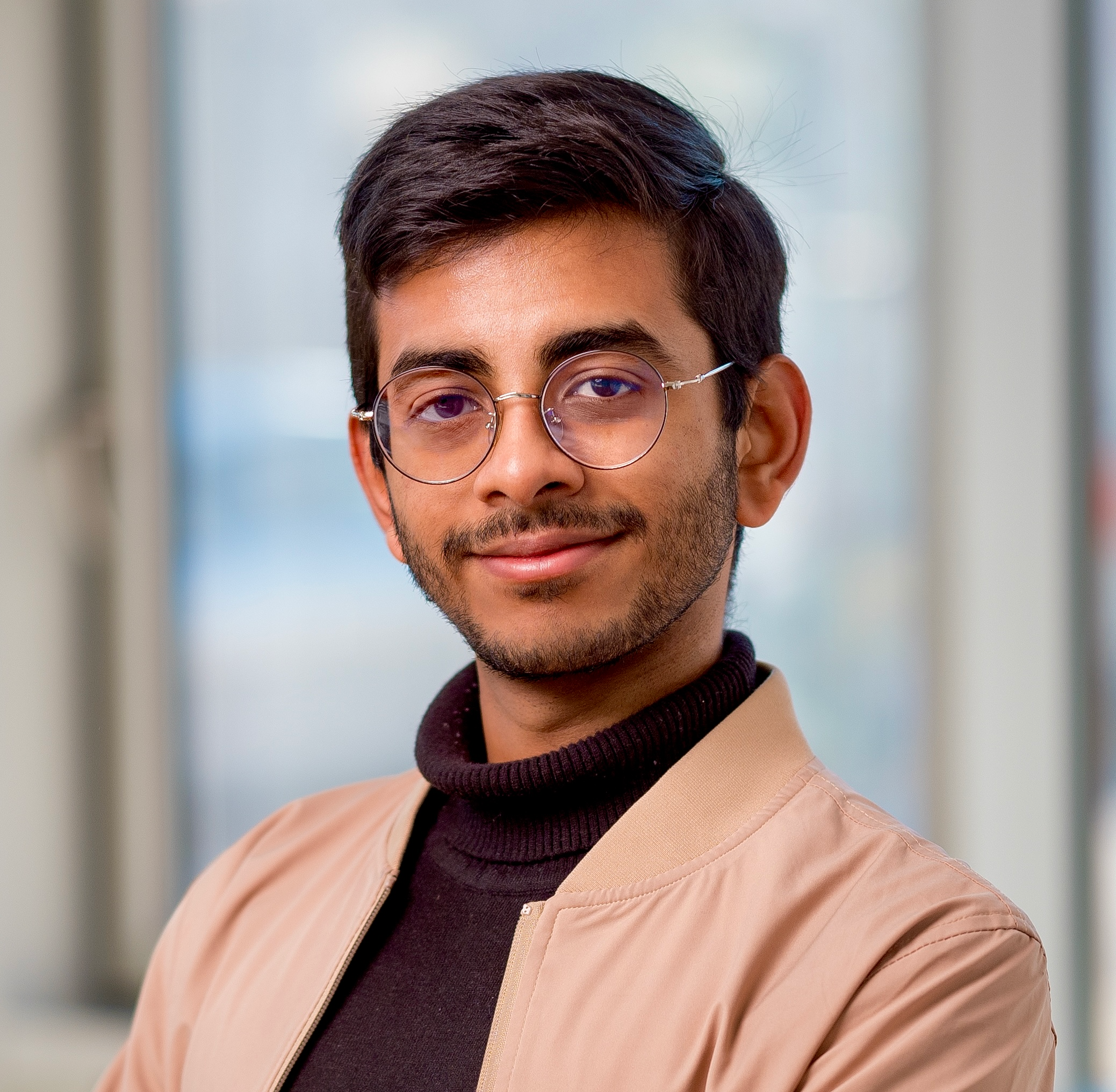
I am a second-year master’s student in Computational Neuroscience at the GTC, University of Tübingen and an IMPRS MMFD Scholar. I am doing my master’s thesis with Peter Dayan and Roxana Zeraati at the Max Planck Institute for Biological Cybernetics, studying the problem of optimal foraging for resources under partial observability in dynamically changing environments.
Earlier this year, I did an essay rotation at the Max Planck Institute for Intelligent Systems with Bernhard Schölkopf and Lancelot Da Costa on growing causal abstractions in brains and machines.
Research
I am interested in understanding the first principles of intelligence as they appear in living systems and, increasingly, in machines. Intelligence naturally emerged from the pressures of survival and procreation through brains, specialised biological machinery that natural selection came to exploit across the countless life forms trotting, slithering, flapping and swimming across our planet.
A core problem that brain-possessing life forms evolved to solve is foraging, i.e. a search for food or mates in a complex, ever-changing world replete with threats and uncertainties, which entails learning and planning for adaptive control. The mechanisms by which brains with diverse capacities and architectures across various ecological niches solve this problem are not well understood. I therefore study the problem of foraging as a means of uncovering general principles of natural intelligence that may (or may not) guide the study and development of artificial intelligence.
I use the framework of reinforcement learning (RL) to construct foraging environments in which artificial agents learn and plan to behave optimally under resource constraints. I use neurobiologically plausible recurrent neural networks as RL agent architectures and study the dynamical systems solutions they discover to generate hypotheses that would be tested against behavioural and neural data from animals and humans.
Highlights
04/2026 Began Master’s Thesis at the Computational Neuroscience Lab
04/2026 Awarded IMPRS MMFD Scholarship
03/2026 Completed Essay rotation at MPI-IS
12/2025 Completed Lab rotation at MPI-KYB
10/2024 Began M.Sc. in Computational Neuroscience at Tübingen
06/2024 Graduated with Honours in B.Tech. Computer Engineering.
03/2024 Paper on LLMs accepted at the SemEval 2024 Workshop
08/2023 Completed Summer Research Internship at TU Munich
07/2023 Paper on DEM super-resolution published at IEEE IGARSS 2023
01/2023 Awarded DAAD-WISE Scholarship
Publications
Natural Building Blocks for Structured World Models: Theory, Evidence, and Scaling
L. DaCosta, S. Namjoshi, M. A. Ansari, B. Schölkopf
World Modeling Workshop, 2026
[PDF]
JMI at SemEval 2024 Task 3: Two-step approach for multimodal ECAC using in-context learning with GPT and instruction-tuned Llama models
Arefa, M. A. Ansari, C. Saxena, T. Ahmad
ACL SemEval Workshop, 2024
[PDF] [Code]
Master GAN: Multiple Attention is all you Need: A Multiple Attention Guided Super Resolution Network for Dems
A. Mohammed, M. Kashif, M. H. Zama, M. A. Ansari and S. Ali
IEEE IGARSS, 2023
[PDF] [Code]